
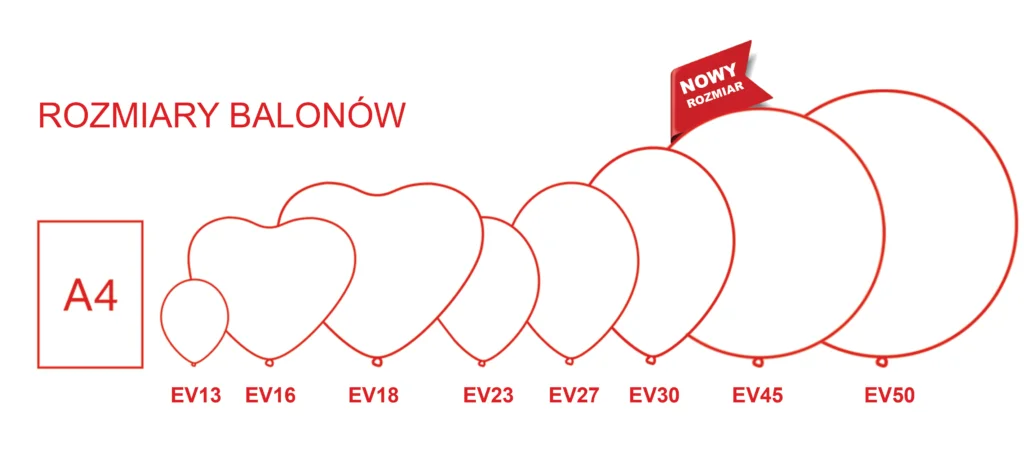
Balloon sizes are crucial when planning any balloon decoration – whether you’re creating a spectacular garland, decorating a ceiling, or making a minimalist balloon bouquet. In this practical step-by-step guide, we explain which small balloon, medium balloon, or large balloon works best for specific uses. It’s the perfect cheat sheet for both professional decorators and DIY enthusiasts preparing decorations at home.
Keep in mind that balloons can be inflated less or more – achieving a smaller or larger diameter than stated.
Key Informations
- Why does balloon size matter?
- Classification of latex balloon sizes
- Which balloons for garlands?
- Balloons for bouquets and accents
- Ceiling installations and giant balloons
- How to combine different balloon sizes?
- Most common mistakes when choosing size
- FAQ
Why does balloon size matter?
Choosing the right balloon size affects the final visual impact and durability of the decoration. An oversized balloon in a tight space can look disproportionate, while a tiny one may get lost in the composition. Each size serves a different purpose. Understanding their properties is the foundation of professional decoration – whether it’s a garland, bouquet, or balloon wall.Classification of latex balloon sizes
Here are the most commonly used balloon sizes in inches and their applications:| Size (inches) | Diameter (cm) | Description and use |
|---|---|---|
| EV13 (5”) | approx. 12 cm | Helper balloons, ideal for fillers, details, and depth effect |
| EV23 (10”) | approx. 23 cm | Standard size for garlands and table decorations |
| EV27 (11”) | approx. 27 cm | Popular balloons for bouquets and garlands |
| EV30 (12”) | approx. 30 cm | Most popular balloons for bouquets and garlands |
| EV45 (18”) | approx. 45 cm | Large balloons – perfect as accent points |
Which balloons for garlands?
When creating a balloon garland, it’s best to combine medium balloons (10–12 inches) as the base with small balloons (5 inches) as fillers and details. This arrangement creates a three-dimensional effect and natural irregularity, which looks much better than uniform, monotonous spheres. For large garlands, also add single 18-inch balloons – as focal accents. They give the composition “breathing room” and draw the eye.Balloons for bouquets and accents
For balloon bouquets, 10” and 12” balloons are most commonly used. 5” balloons are too small to make an impression on their own but work great as add-ons or to fill gaps between larger balloons. Pro tip: use clear 12” balloons with confetti as the centerpiece of a bouquet – guaranteed WOW effect!Ceiling installations and giant balloons
Large balloons (18 inches) make the biggest impact in open spaces – especially in hanging decorations, e.g., over a dance floor, chill zone, or entrance. For ceiling decorations, use balloons of various sizes: from 5” to 18”, creating a layered and dynamic space. It’s worth combining EV45 balloons with metallic or chrome-finish ones – this enhances their premium look.How to combine different balloon sizes?
The best balloon compositions come from size contrast. Here’s a proven recipe:- base: 12” balloons
- filling: 5” balloons
- accents: 18” balloons
Most common mistakes when choosing size
- Using only one size – A garland made solely of 12” balloons looks flat and lacks dynamics. Always add small and large elements.
- Too-large balloons in small spaces – 18” balloons in a small room can overwhelm. In such cases, stick to 10–12 inches.
- Lack of proportion – Large balloons need “surroundings” – smaller balloons that add lightness to the composition. Otherwise, the effect can feel clunky.
Frequently Asked Questions:
What size balloons should I choose for a garland?
12” balloons work best as the base, 5” as fillers, and 18” as accents. This set allows you to create a striking, three-dimensional garland.
Can balloons be inflated to smaller sizes than stated?
Yes. A 12” balloon can be inflated to only 10”, which gives more flexibility in designing compositions and prevents bursting under high pressure.
Are 18″ balloons difficult to install?
No, but they require more weight or proper anchoring. It’s best to use them as central decorative points – at the entrance, in the middle of the room, or in the photo zone.