
Key Information:
- Types of modeling balloons
- Essential tools and accessories
- Basic balloon twisting techniques
- Simplest balloon animals – step by step
- Inspiration: simple balloon decorations for beginners
- Common beginner mistakes and how to avoid them
- FAQ – frequently asked questions
Types of modeling balloons
Balloon modeling is an art that begins with choosing the right materials. Modeling balloons, also known as “snake” or “twister” balloons, are made from high-quality latex and have an elongated shape. Their flexibility allows for creating complex shapes and figures. The most common size is:260 – classic size (2 inches wide and 60 inches long when inflated), ideal for beginners
Essential tools and accessories
Before you start making your first figures, prepare a few basic tools:- Balloon pump – preferably a manual, double-action one, specially designed for thin-neck balloons
- Permanent marker – for adding eyes, noses, and other details
- Scissors – useful for trimming ends
Basic balloon twisting techniques
Every balloon animal starts with learning a few fundamental twists:- Basic Twist: The simplest twist – bend the balloon at the desired spot and rotate it several times while holding both ends.
- Ear Twist: Create a small bubble loop and twist it against a larger segment – perfect for making ears or noses.
- Loop Twist: Form a loop from part of the balloon and twist – often used for paws, feet, or wings.
- Lock Twist: Used to “lock” two twists together – essential for building stable structures.
Simplest balloon animals – step by step
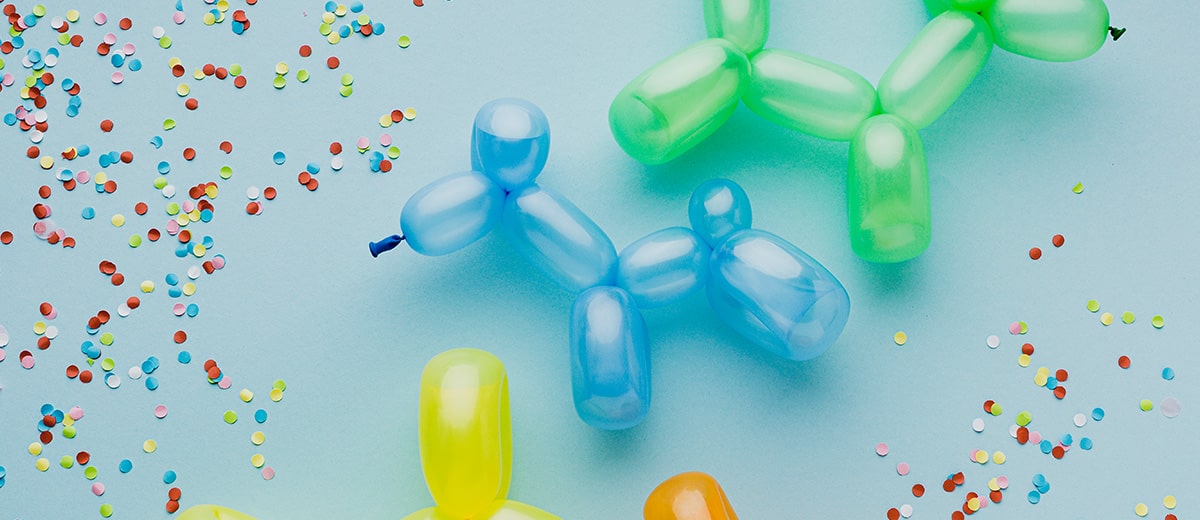
Balloon dog – instructions
- Inflate the balloon, leaving about 10 cm uninflated at the end.
- Make three twists: first (head), second and third (ears), then do a Lock Twist.
- Create the body (about 8 cm), then two front legs and another Lock Twist.
- Repeat the process for the back legs.
Balloon mouse
- Inflate almost the entire balloon.
- Form a small head, two ear loops, and a Lock Twist.
- Add a tail and draw eyes with a marker.
Inspiration: simple balloon decorations for beginners
Beyond figures, it’s worth learning to create decorations. Here are a few ideas you can easily make yourself:Balloon animal bouquet
Create 3–5 different figures and attach them together on sticks – perfect as a birthday gift.Mini garland from snake balloons
Use snake balloons in different colors, twist them into light zigzags, and connect into a spiral – a great decorative effect for photo backdrops.Balloon hat
Using a loop as the base, create a “crown” with additional figures (e.g., a dog, heart, or flower). Modeling balloons are a fantastic addition to events, children’s parties, kids’ entertainment, and creative workshops. You can find them in a full color range here: modeling balloons.Common beginner mistakes and how to avoid them
Here are typical problems beginners face:- Over-inflating – the balloon needs an air reserve, or it will burst on the first twist.
- Incorrect twisting – twists should always be in the same direction to prevent the structure from falling apart.
- Using cheap balloons – low quality leads to frequent bursting and frustration.
FAQ – frequently asked questions
What balloons are best for modeling?
Latex balloons in size 260 are the best – they are durable and flexible.
Are modeling balloons safe for children?
Yes, provided they are made from certified materials and children are supervised during play. Avoid latex contact in case of allergies.
Why do my balloons burst when twisting?
This usually results from over-inflation, twisting in different directions, or low-quality balloons. We recommend using balloons from trusted manufacturers.